


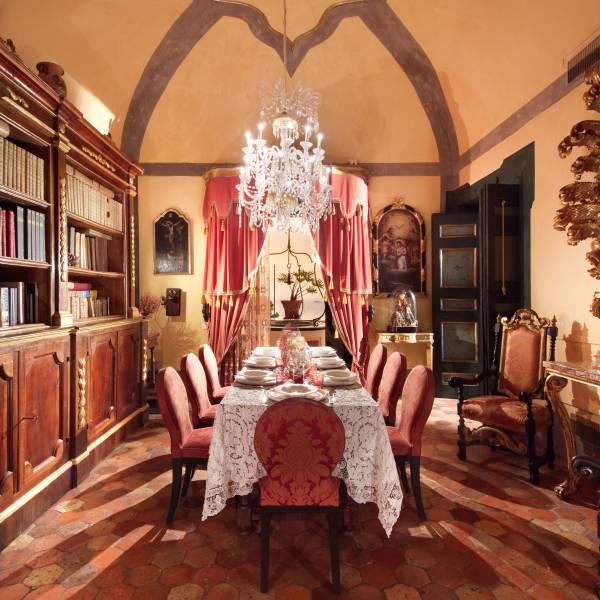
Here is what Marco Morello writes on Panorama, January 8, 2020
Read the original article in PDF
This house is a Restaurant
A dinner or an aperitif in a luxury residence, surrounded by works of art or in front of a spectacular view. A rapidly growing trend is dining at someone else’s home without knowing the owner. Just book online and enjoy the experience.
No matter how attentive and refined the service may be, it will always seem distant and impersonal. No matter how splendid and opulent the room may be, it will still convey a sense of studied artificiality. A restaurant will never have the warmth, the sum of genuine care and details of a home. This is proven by an aperitif or a dinner at someone else’s home, which no longer requires a prerequisite of friendship or kinship with the owners. It’s not about crashing into any home hoping to blend in with the guests, but about turning to one of the many online platforms that allow you to book a gastronomic experience in a residence. Even better if it’s historic, luxurious, right in the city center.
There is something for every voyeuristic appetite: you can peek at what it’s like to live in a bizarre kind of museum with a dining room and bedroom, nibbling on delicacies in close contact with statues and paintings. Or, for the duration of a meal, discover what it’s like to reside inside an ultra-modern historic building with a breathtaking view. To immerse oneself, as paying and therefore welcome intruders, into the domestic hearth of a stranger. Yes, just like Airbnb, except the host doesn’t leave; instead, they cook, serve at the table, and even sit down to chat with us.
The formula is simple: choose from a range of options, joining one of the proposals published online (some examples can be found on these pages), or, in a burst of romanticism, request exclusive use of the house, an option that naturally increases costs. It can reach up to a thousand euros per couple if there’s a chef preparing a personalized menu, but on average, it costs much less, from 30 euros per person for shared meals among strangers, allowing for new friendships to form, or, who knows, something more to blossom.
The idea that the table is the primordial social network is indeed the pillar of Eatwith, the international leader in the field. It is present in 965 destinations across 130 countries, including ours, with 15,000 total offers to choose from globally. Meanwhile, the Italian network Cesarine, with 700 amateur cooks spread across 120 cities in the Bel Paese. The spirit is the same: “Guests are treated like friends, welcomed, asked for their name and origin. They often take off their shoes and make themselves completely at home.” Speaking is Paola, a Cesarina from Bologna, who doesn’t attribute much weight to the grandeur of the residence, but rather to the quality of the atmosphere: “Conviviality is the main ingredient. The beauty of the house matters a lot, but it’s not enough. There are beautiful homes, but they are cold, without personality. What fascinates guests is a welcoming home.”
The trend, moreover, has a rather fitting name: it’s called social eating. Satisfying oneself while socializing. And it is expanding. In the first half of 2019, Cesarine recorded a 76 percent increase in customers compared to twelve months earlier, while through its Home Food Observatory, it was able to certify how the trend enchants foreigners visiting Italy: of the 12 billion spent in a year by tourists on food and gastronomic experiences, almost 3 go to consumption occasions beyond traditional dining. Just like social eating.
Another proof of the boom is the flourishing of sites to turn to, each with its own focus. Take Homeating, which makes the obsessive selection of residences its strength. The portfolio is constantly evolving, the common element is luxury, the refinement of the addresses: “We had the intuition to make private residences of noble, aristocratic families, collectors, or architects accessible,” says Carolina Pignata, founder of Homeating with her partner Marcella Buccino.
“We can organize everything tailored,” says Pignata. “We satisfy those looking for a palace with frescoed interiors or those who want to dine among pieces of contemporary art or ancient musical instruments.” The owners care a lot about their privacy (and the safety of their treasures) and need to be reassured. “Then, they are the first to be enthusiastic: They participate in the dinners, explain to the guests how they have organized the spaces. The evenings extend, no one wants to leave.”
Fresh is the debut of the project A Casa… Veronelli, launched in Courmayeur during the Christmas period and ready for replication with other stops throughout 2020. The idea is to create a hybrid, combining the tradition of the best home-cooked food with high-level hospitality, worthy of an exclusive club. Once again tickling that desire that is at the base of everything: not going to places seen and seen again. Sitting at a stranger’s table means standing out. At least until the exception becomes a habit, until we are asked, without a hint of surprise, whether we recommend or not the house of the perfect stranger where we dined the other night.
Click on the image below to read the original article.

